Roofing decisions, explained
What Affects Roof Repair Cost in Baytown?
Roof repair cost in Baytown depends on what failed, how much of the roofing system must be opened and what is found underneath. A ceiling stain or a missing shingle is a starting clue, not enough information for a reliable price. Compare the work described in an estimate before comparing the total, and ask how hidden damage will be handled.
Why the same visible leak can lead to different repairs
Two homeowners can report a stain beside a window and need quite different roofing work. One roof might have a localized flashing defect at a wall. Another might have damaged covering over a wider area, with water reaching the wood below. The stain describes where water became visible indoors. It does not establish the entry point, the size of the outside repair or the condition of concealed materials.
A useful roof repair estimate therefore begins with a diagnosis and a defined scope. Diagnosis asks where water is entering and which details have failed. Scope identifies the materials that must be removed, repaired or replaced to restore that detail. A proposal based only on coating the visible surface can describe less work than one that opens the transition and rebuilds it. The difference deserves an explanation rather than an assumption that either total is automatically fair.
If the source is uncertain, ask what the first assessment can establish and what may require additional investigation. A candid limit is more useful than an exact figure built on an untested assumption. For an active problem, request roof leak assessment and repair with the location of the symptom, when it occurs and any previous work.
The roof detail changes the work involved
Shingles and the layers beneath them
Replacing a damaged shingle is different from restoring an area where the underlayment or decking is also affected. Underlayment is the protective layer beneath the roof covering; decking is the wood surface supporting the roof system. An estimate should distinguish the visible covering from these underlying layers. If the wood cannot be evaluated until materials are removed, that uncertainty belongs in the written scope.
Even a focused shingle repair can involve neighboring shingles. GAF's storm-repair bulletin explains that lifting or disturbing shingles can break their adhesive seals, and those affected shingles may require hand sealing according to the applicable instructions. That is a reason to ask what the repair includes around the visibly damaged piece. It is not evidence that every small defect requires a large replacement.
Flashing, vents and roof-to-wall junctions
Flashing directs water around a roof interruption or a junction between surfaces. At a wall, layered metal details work with shingles and the adjoining wall covering. Around a pipe or other penetration, a flashing assembly connects the opening to the roof's water-control layers. Repair may require access to more than the part visible from the ground so those materials can drain in the correct direction.
Ask whether a proposed repair replaces a deteriorated component, restores an incorrectly integrated detail or applies a limited surface treatment. Those are different scopes. The contractor should explain why the chosen method suits the observed condition, rather than describing every flashing problem as a need for caulk.
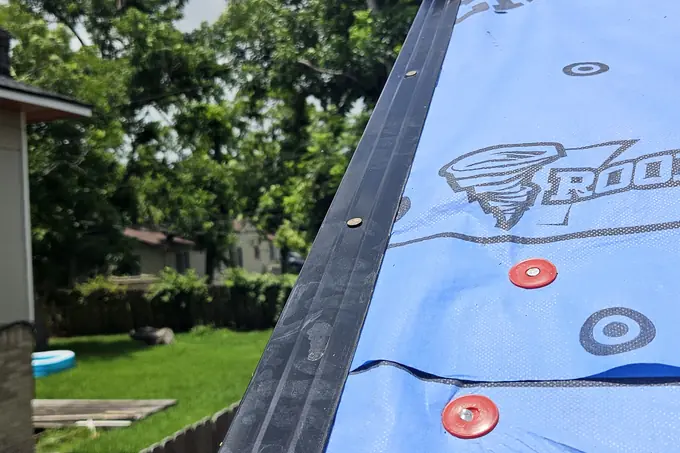
Access and the affected area belong in the estimate
The homeowner can help an assessor understand the property without trying to measure or climb the roof. Describe whether the symptom is near a wall, chimney, porch, garage or upper roof. Mention additions and any areas that are difficult to reach from inside the house. Include safe ground-level photographs if they show the relevant elevation. These observations improve preparation; they do not replace the contractor's assessment of access.
A repair area and a roof's floor-plan area are not interchangeable. The material that must be opened can extend beyond the visible defect to reach a sound connection or expose an adjoining interface. Ask the estimator to identify that boundary in a photograph or description. If the repair touches several transitions, ask whether each is included or only one suspected entry point.
Keep practical work separate from assumptions about the cause. Difficult access can change the method used to reach a detail, but it does not prove the roof requires replacement. Similarly, a broad stain does not necessarily mean a broad area of covering failed. The estimate should connect the proposed work to the evidence at this property.
Hidden decking damage needs a clear change process
A covering repair can uncover wood that needs further attention. Before accepting the proposal, ask how the contractor will document that finding, describe the additional work and obtain your agreement. The point is to understand what the initial estimate does and does not purchase. Do not assume a fixed total includes unlimited concealed damage, and do not assume every contractor excludes the same items.
For work inside Baytown's permitting jurisdiction, the city lists shingle-only replacement among its permit-not-required examples and roof deck installation, replacement or repair among permit-required work. A change from covering work to decking work can therefore change more than the material quantity. The actual address and project scope need checking with Building Services. This city distinction does not settle windstorm certification or another municipality's rules.
Ask who will confirm applicable paperwork and whether any required inspection needs to be arranged before materials conceal the work. These are planning questions, not a promise that every roof needs a certificate or that the receiving provider performs official inspections. A written estimate should leave you knowing who is responsible for resolving each applicable requirement.
Compare inclusions before choosing a proposal
| Ask about | What a useful answer clarifies |
|---|---|
| Failure and evidence | The observed problem and why the proposed method addresses it. |
| Removal and replacement | The components, transitions and area included, with product details where known. |
| Underlying layers | What is visible now and how concealed damage would be assessed. |
| Completion | Disposal, cleanup, documentation and any stated written warranty. |
| Changes | How additional work is explained and approved before proceeding. |
Use the same questions with each estimator. A lower total may reflect a smaller scope, while a higher total may include work you do not yet understand. Ask for that difference to be explained in ordinary language. The objective is a proposal you can evaluate, not the longest list of roofing terms.
Keep product warranty and workmanship warranty questions separate. Product coverage concerns the manufacturer's written terms; workmanship coverage concerns installation under the contractor's stated agreement. Neither should be assumed from a logo or a general phrase such as guaranteed work. Ask for the terms that would apply to the actual proposed repair.
Repair cost is also a question of whether the scope fits
A focused repair can be sensible when an identified local defect can be corrected and the surrounding roof can support the work. Replacement becomes a different decision when deterioration or failures extend beyond a useful repair boundary. NRCA notes that a leak does not by itself mean the whole roof needs replacement. Inspection should establish the reason for the recommendation.
Ask what would happen if the limited repair were completed and what problems would remain outside its scope. That helps separate an appropriate small repair from repeated treatment of an unresolved system problem. It also prevents an isolated defect from becoming an unsupported replacement recommendation. Age, previous work and visible condition are inputs to that conversation, not automatic verdicts.
If an estimate includes both repair and replacement options, compare what each resolves, what it leaves in place and which uncertainties remain. Do not make the decision from a hypothetical life-extension figure or an assumed insurance contribution. Neither can be established for your property from a general website guide.
What to send with a repair enquiry
Provide the property address, the affected room or roof area, when the problem was first noticed and whether water entry is continuing. Add earlier repair dates or invoices if available. Describe any visible missing shingles or storm-related changes from a safe location. You do not need a guessed roof area or a diagnosis to start an enquiry.
Baytown Quality Roofing is an independent enquiry website referring requests to Sure Claim Roofing. Requesting an assessment does not confirm an appointment, a final price or insurance coverage. The next useful step is an explanation of the likely source and the work needed to address it. Use the roof-condition inspection enquiry if the problem is uncertain or you need help comparing possible scopes.
BEFORE YOU DECIDE
Answered Questions
Can I get a dependable roof repair price from a photograph?
A photograph can help describe a symptom, but it may not show the source, surrounding materials or concealed damage. Ask whether an initial figure is a planning assumption or a written estimate based on an on-site assessment, and what conditions could change it.
Does a bigger ceiling stain mean a more expensive repair?
A bigger stain does not establish the size of the outside repair. Water may become visible away from its entry point, and the repair scope depends on the failed detail and affected layers. Document the symptom and ask how the diagnosis supports the proposal.
Should I choose the lowest repair total?
Choose a scope you understand before judging the total. Check whether the proposals address the same failure, include the same components and explain hidden-damage changes. An unexplained difference deserves a question rather than an automatic decision.
Does this guide provide Baytown repair prices?
No. It explains the factors behind a repair estimate without publishing an unverified local price range. A property-specific scope is needed before the receiving contractor can explain the proposed work and its terms.
A CLEAR NEXT STEP
Tell us what’s happening with your roof.
Request a no-obligation inspection from SureClaim. They’ll confirm the scope, options and availability with you.