Roofing decisions, explained
A Homeowner Roof Inspection Checklist
A homeowner roof inspection checklist should help you collect safe observations and prepare questions, not send you onto the roof. Record visible changes from the ground, indoor symptoms and known repair history. Then ask a qualified roofing professional to assess the condition, explain the limitations and recommend the appropriate next step.
Know what this checklist can and cannot do
This checklist is preparation for a roofing conversation. It does not certify the roof, identify every defect or establish whether the home complies with a code or insurance requirement. Those tasks can require different qualifications, access and official processes. A homeowner's photographs and notes are useful inputs, not a substitute for the relevant professional assessment.
NRCA advises professional attention to roofing problems and warns against the risks of homeowner roof work. Its storm guidance recommends assessing visible damage from the ground and having a professional perform closer evaluation. Follow that boundary even if a ladder or an upper window seems to offer a better photograph.
Keep a distinction between observation and conclusion. You can observe a stain after rain, a missing-looking patch of covering or loose material on the ground. You cannot establish the condition of concealed decking or the correct repair method from those facts alone. A good enquiry makes that distinction clear rather than requiring you to diagnose the problem before asking for help.
Collect the roof history you already have
Look for the installation date, prior repair invoices, product information and any written warranty documents. If the records are incomplete, identify what you know and what is approximate. An old real-estate document or a remembered date can be useful context without becoming a precise roof age or a remaining-life forecast.
List earlier symptoms and the work intended to address them. Note whether a leak stopped, returned at the same place or appeared elsewhere after the repair. Keep the earlier proposal as well as the invoice if both exist: they may describe the scope more clearly than a short payment receipt.
If you have existing windstorm or other inspection records, keep them available for the discussion. Do not assume a certificate confirms the current condition of every component or replaces an assessment after new damage. Also do not assume every Baytown-address property needs the same paperwork. The actual location, program and work determine the question.
Make safe ground-level observations
- Look at the roof from safe positions already accessible at ground level. Note the elevation or roof area where a visible change appears.
- Record conspicuous missing or displaced material without trying to count every affected piece or reach it.
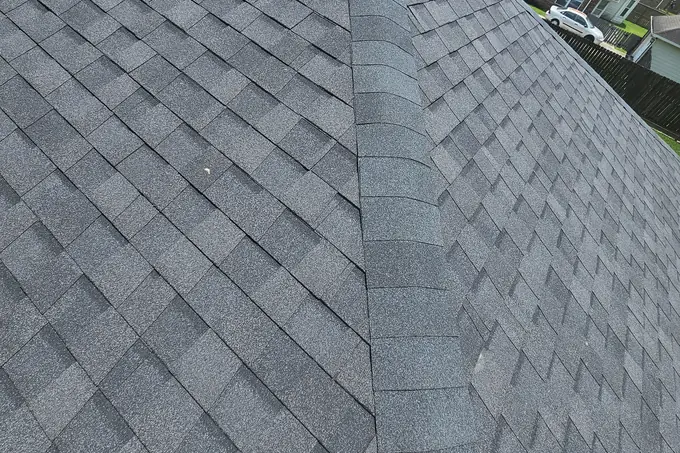
- Photograph the general roof area for context, then any visible detail you can capture safely.
- Note nearby features such as a wall junction, chimney, vent or lower roof, using ordinary descriptions.
- Write down the date and conditions of your observations. Separate what you saw from what you believe caused it.
Do not lift shingles, remove sealant, climb onto the roof or install temporary protection as part of this checklist. Disturbing material can cause damage, and exposed or wet conditions introduce hazards. If the property has an immediate unsafe condition, seek appropriate assistance rather than continue documenting it.
A limited view is still useful when it is described honestly. Tell the assessor if an area cannot be seen from the ground. A missing photograph is better than a risky attempt to prove what is happening. The professional visit should establish what can be assessed under the actual access and weather conditions.
Record indoor symptoms without opening the ceiling
Describe the room, the surface affected and whether there is active water entry. Note when the symptom first appeared and whether it changes after rain. If an older mark has recently changed, record the difference rather than referring only to an old stain. Dated photographs from safe positions can preserve the sequence.
Do not disturb a damaged ceiling or touch wet electrical fittings. Keep clear of an area that appears unsafe and arrange the appropriate help. An active problem may require a different response from a routine condition enquiry, so state that water is entering now if that is the case.
A mark indoors does not identify the outside source. Tell the assessor about the symptom and nearby features without deciding that the shingle directly above it must be the cause. The assessment may need to consider roof transitions, penetrations or other moisture sources. Honest symptom history is the contribution the homeowner can make before a diagnosis.
Ask what the professional assessment will cover
Observed condition and access limits
Ask what will be inspected, what cannot be seen and how findings will be communicated. Weather, access and concealed materials can limit a visit. A clear explanation should identify those limits rather than imply that every part of the roof can be evaluated from one position or photograph.
Ask whether the assessment is a roof-condition visit or an official inspection required for a permit or windstorm process. These are different services. The receiving roofing provider should not be assumed to issue official certificates merely because it offers roof inspections.
How findings become a work recommendation
Ask the assessor to connect each recommended item to an observed condition. If repair is appropriate, what is the boundary and what surrounding materials remain? If replacement is recommended, what broader condition makes a focused repair unsuitable? NRCA notes that a leak alone does not mean replacement is necessary, so the explanation should go beyond that symptom.
Request written scope and ask how any concealed damage found later would be documented and agreed. You should understand what the proposal resolves, what it excludes and what remains uncertain. That understanding is useful whether the project is a small repair or a wider replacement.
Keep paperwork questions tied to the address and work
Inside Baytown's jurisdiction, the city lists shingle-only replacement separately from roof deck installation, replacement or repair in its residential permit examples. A proposal that changes from covering-only work to decking work can therefore raise a different permitting question. Do not apply that city's exemption to a neighboring municipality.
Windstorm inspection and certification are separate from the city permit question. TDI describes different certificates for ongoing and completed work, and the applicability depends on the relevant location and project. Ask who will confirm the requirements and whether any inspection must be planned before the work is covered.
You do not need to solve the official rules before requesting an assessment. You do need a clear responsibility for checking them once the scope is known. Keep any official requirement, contractor condition assessment and insurance decision identified as separate tasks so one document is not assumed to answer all three.
Turn your notes into a useful enquiry
Send the property address, the main reason for the visit and whether water is entering now. Add known roof age, prior repair details and a small set of safe photographs that show the relevant context. Include your contact details and any practical access information the provider needs to discuss an appointment.
Do not send unrelated financial, identity or policy documents simply because they are in the same folder as the roof records. Begin with information needed to understand the property and symptom, then provide other material through an appropriate channel if it becomes relevant. A concise, accurate history is more helpful than a large collection with no explanation.
Baytown Quality Roofing is an independent website referring requests to Sure Claim Roofing. Request a roof-condition assessment when the main task is understanding condition. Choose roof leak repair enquiry for a suspected leak or urgent roofing enquiry for active water entry. The provider must confirm availability and the visit's scope.
BEFORE YOU DECIDE
Answered Questions
Should I walk the roof before the contractor arrives?
No. Use safe ground-level observations and existing records. Professional inspection is intended to evaluate details you cannot safely or reliably assess yourself. Do not lift materials or climb onto the roof to complete a checklist.
What if I do not know the roof age?
Say that the age is unknown or approximate. Share any installation or repair records you have, but do not turn an estimate into a fact. Current condition and the observed failure still need assessment.
Does a roof-condition inspection include windstorm certification?
Not automatically. A roofing assessment and an official windstorm inspection or certificate are different tasks. Ask which service is being offered and who will check any address-specific certification requirements before the work.
How many photographs should I send?
Send a manageable set that shows the whole affected area and useful detail from safe positions. Include dates and a short description of what each image shows. There is no required photograph count, and an image does not replace an assessment of concealed conditions.
A CLEAR NEXT STEP
Tell us what’s happening with your roof.
Request a no-obligation inspection from SureClaim. They’ll confirm the scope, options and availability with you.