BEFORE THE WORK STARTS
Do Roof Repairs Need a Permit in Baytown?
Baytown lists roof shingle replacement only among work that does not require a residential permit. Roof deck installation, replacement or repair is on its permit-required list. Confirm the actual address and proposed work with Building Services before relying on that distinction.
Baytown roofing permits depend on the work beneath the shingles
The useful first question is what the contractor intends to alter. A description such as “roof repair” can mean replacing damaged covering, opening a wall transition or replacing deteriorated wood beneath the covering. These are different scopes even when they address the same ceiling stain. A photograph of the outside rarely settles which work will be needed.
The City of Baytown residential permit page separates shingle-only replacement from roof deck work. Read the word “only” carefully. Ask for a scope that identifies the covering and any supporting material separately, rather than treating every item on a roofing estimate as one interchangeable repair.
What roof decking means in this conversation
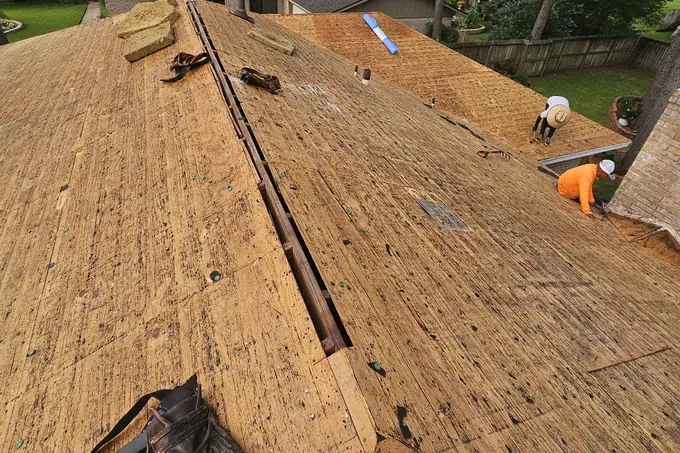
Decking is the sheathing beneath the roof covering, not the shingles visible from the street. If a proposal mentions damaged plywood, sheathing or deck replacement, flag that language when asking the city about the project. You do not need to determine the construction detail yourself. You need a clear account of what will be removed, what may be exposed and what the contractor proposes to replace.
Confirm the property jurisdiction before using a city exemption
A Baytown postal address does not by itself establish every authority responsible for a project. Give the property address to Building Services and ask whether the site is within its permitting jurisdiction. For a property elsewhere, ask the authority responsible for that address. Do not copy a rule from a nearby home simply because the houses share a ZIP code or use the same roofing company.
This matters when comparing enquiries across Baytown, Highlands, Mont Belvieu, Beach City and Crosby. An estimate prepared for one address is not a permit ruling for another. The homeowner can keep the process simple by asking the contractor to state which office has been consulted and which scope that answer covers.
Send the question with a defined scope
Instead of asking “Do I need a roofing permit?”, describe the proposed work in ordinary terms. For example: damaged shingles are to be replaced, decking condition is not yet visible, and any proposed sheathing repair will be documented before proceeding. Ask what to do if that second part becomes necessary. The answer is more useful than an exemption assumption made before the roof is assessed.
Plan for a change from surface repair to decking work
An initial assessment may not expose every concealed condition. Before work is approved, ask how the contractor handles a discovery that changes the scope. Who contacts you? What photographs will explain the condition? Who checks permit implications? Which further work needs your written approval? Record the answers in the project documents rather than relying on a casual conversation during installation.
Consider a leak repair described as replacement of damaged covering around an entry point. If opening that area reveals sheathing that the contractor proposes to replace, the decision has changed. The homeowner now needs both an explanation of the newly observed condition and a check of the revised permit responsibility. The original description should not quietly carry forward as though nothing changed.
Agree on the pause and approval process
Ask what can be safely protected while the revised decision is made. Do not instruct a crew to leave exposed work unprotected while waiting for paperwork, and do not approve an unexplained expansion because the job is already underway. Have the contractor explain the protection and approval sequence before a concealed-condition discovery makes the conversation urgent.
Keep municipal permits and windstorm certification separate
A city permit exemption is not an answer to every windstorm-inspection or insurance question. These are separate checks with different purposes. If the property and improvement fall within the applicable windstorm program, ask about certification independently of the city permit question. Avoid using a statement about shingles alone to dismiss an inspection requirement that has not been reviewed.
In particular, the Texas Department of Insurance distinguishes designated coastal areas from the rest of the state. Chambers County is included, while its Harris County description names particular cities and locations. Do not turn “near Baytown” into a universal certification conclusion. The property location, proposed work and relevant insurance requirements need to be checked together.
Your practical record can have two separate entries: the local office's answer about the defined roof work, and the inspector or insurance contact's answer about windstorm compliance where applicable. One entry should never be substituted for the other.
Put responsibility for permits into the written roofing scope
A homeowner should be able to read the proposal and identify who is responsible for the applicable approvals. Ask whether the contractor will obtain required permits, whether any owner action is needed, and which inspections or final records belong to the agreed project. If an item is excluded, have the exclusion explained before work is scheduled.
| Project question | What to record |
|---|---|
| Where is the property? | Exact address and the responsible local authority. |
| What is being changed? | Covering work, any decking work and relevant structural alterations. |
| What if hidden damage is found? | Photographs, revised scope, approval and permit recheck. |
| Who handles the paperwork? | Named responsibility and the records expected at completion. |
These are planning questions, not a claim that every project needs every document. The answer should fit the actual work. Ask for clarification if the written scope and the verbal explanation describe different projects.
Request an assessment before deciding the final paperwork
The immediate goal is a defined repair decision. Tell the roofer where water appeared, what visible damage you can see safely from the ground, and whether previous repairs have been attempted. Provide the property address early so jurisdiction questions can be considered alongside the roof condition.
If you are weighing a partial repair against replacement, ask for separate explanations rather than assuming the paperwork determines which option is technically appropriate. A permit decision does not diagnose a leak, and a roof assessment does not replace the local authority's decision about approvals.
Request a roof inspection through SureClaim Roofing to discuss the visible problem and proposed scope. Baytown Quality Roofing is the independent enquiry website. SureClaim confirms service fit, arrangements and the roofing work directly. General information here does not authorize construction at a particular address.
BEFORE YOU DECIDE
Answered Questions
Does shingle-only replacement always mean no paperwork?
No. Baytown’s city permit example addresses shingle-only replacement within its scope. Property jurisdiction, other proposed work and any separate applicable inspection requirements still need checking.
What should I ask if the contractor finds damaged plywood?
Ask for photographs, the revised decking scope, your approval process and confirmation of the applicable permit requirements before further work is authorized.
Can I use Baytown’s rule for a nearby town?
No. Ask the authority responsible for the actual property. A nearby address or shared ZIP does not establish the same permit rules.
Who makes the final permit determination?
The responsible local authority decides how its requirements apply. The roofing contractor should provide an accurate scope and clarify who will handle required approvals.
A CLEAR NEXT STEP
Tell us what’s happening with your roof.
Request a no-obligation inspection from SureClaim. They’ll confirm the scope, options and availability with you.